The Cold Night Sleep Kit
The StockTent method for a warm night outside: one number for the night, the bag's Comfort rating and the pad both read against it, the pads you own stacked before you buy, and a camp your bag covers
StockTent's free Sleeping Bag Temperature Guide and Sleeping Pad R-Value Guide each answer one question honestly, and they never meet. The bag guide does not know your pad, the pad guide does not know your bag, and neither knows that your forecast is for a town far below your tent. A bag's rating was measured with insulation underneath it, so the pad is half of the rating. The kit turns your forecast into one number for the night and reads the bag and the pad against it. On the worked example, a +4 °C forecast for a town at 200 m is -1.2 °C at a camp 800 m higher and -4.2 °C once the wind is counted. A bag labeled Comfort -2 °C, Limit -8 °C looks covered by its Limit and is 2.2 °C short by its Comfort rating. The R3 pad is short too, and stacked on the R2 foam pad the sleeper already owns it makes R5, good to about -11 °C. The bag's ceiling on that forecast is 660 m exposed and 1,120 m sheltered, so a sheltered pitch at 1,000 m covers the night with no new bag. Every figure is computed by our calculators; the forecast, elevations and gear are examples, and the 6.5 °C per 1,000 m and the margins are rules of thumb. It plans on the Comfort rating only, never the Limit or Extreme, and carries the carbon monoxide, forecast, trip plan and hypothermia lines. Included: 23 printable pages with seven steps, a night card, a gear inventory, a trip plan card, reference tables in °C and °F and a quickstart, plus a personalised sheet worked from the numbers you enter in our calculators.
Look inside
Two full pages from the kit, exactly as printed. Click either to read it at full size before you decide.
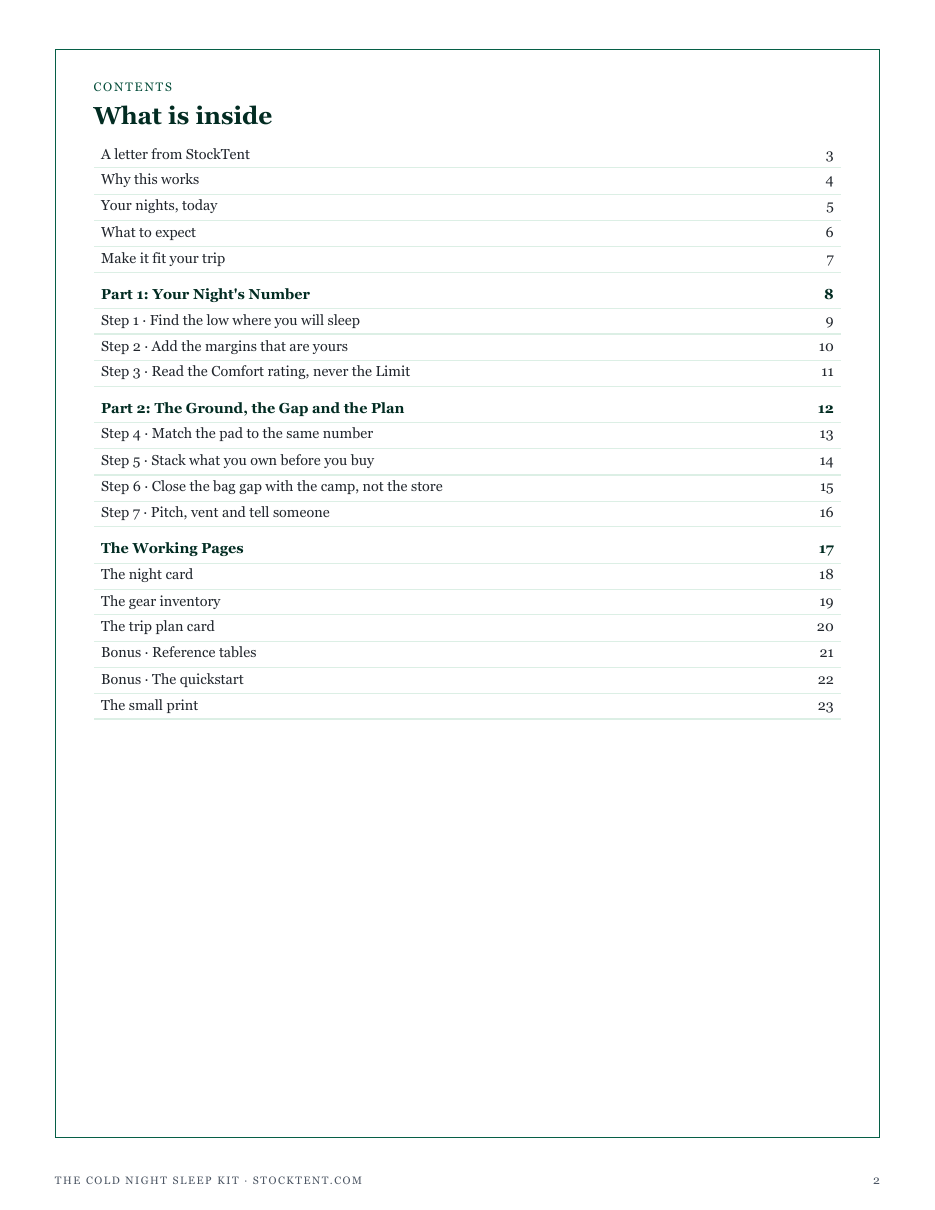
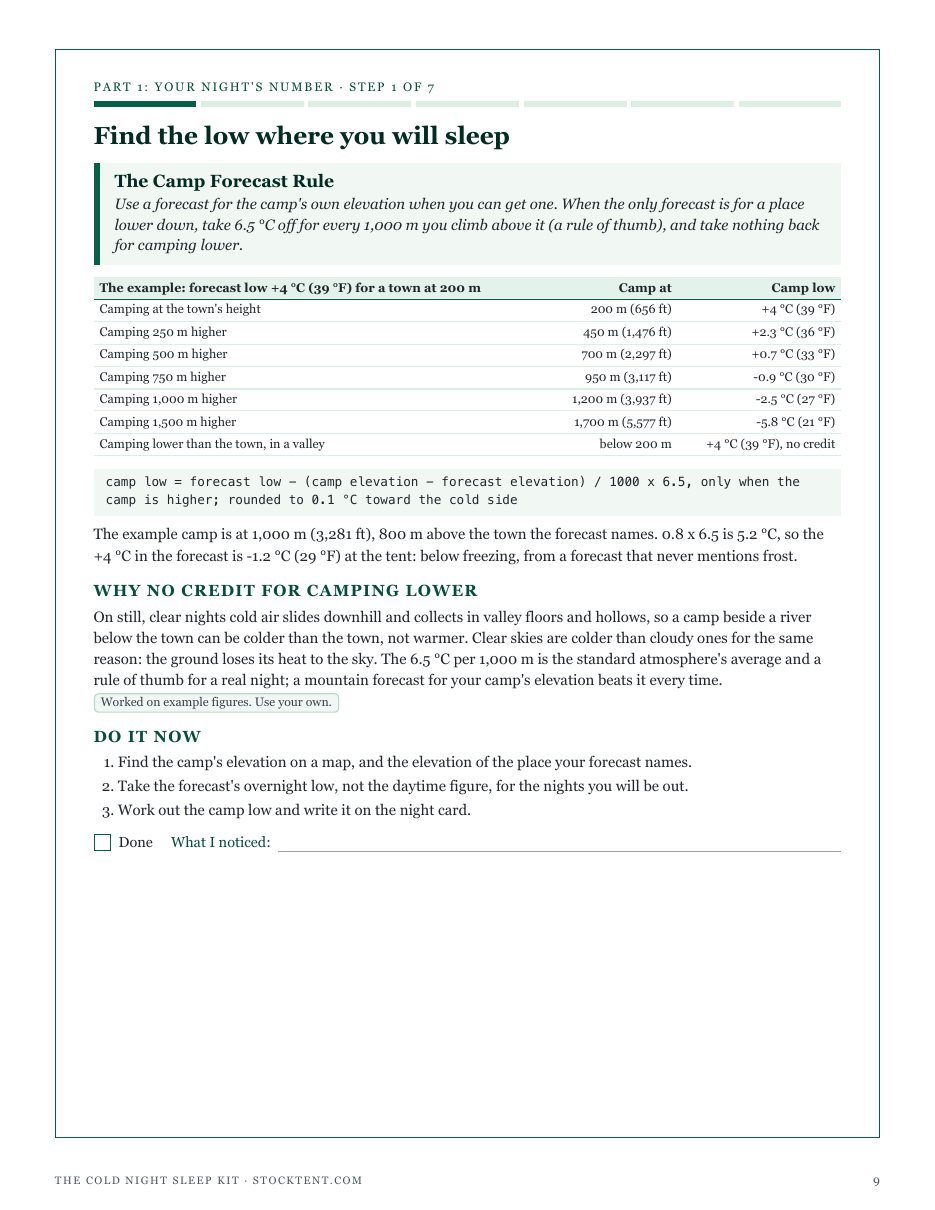
What is in it
- The Camp Forecast Rule: the low at your camp from a forecast for a place lower down, with no credit for camping lower
- The Margin Rule: one number for the night, with margins for cold sleepers and windy, damp or exposed camps
- The Comfort Rule: a bag covers the night only by its Comfort rating, never its Limit or Extreme
- The One Number Rule: the pad's R-value read against the same number as the bag
- The Stack Rule: every combination of the pads you own, before you buy one
- The Ceiling Rule: the highest camp your bag covers on the forecast, sheltered and exposed
- The Go/No-Go Rule: tent size with gear inside, vents, no fuel burning inside, the forecast checked and someone told
- Printable working pages: a night card, a gear inventory and a trip plan card
- Reference tables in °C and °F: degrees colder by climb, pad R-values and bag bands, plus a quickstart
- A personalised sheet worked from the numbers you enter in our calculators
- ✓ 23 printable pages
- ✓ 10 sections, worksheets and templates
- ✓ A second PDF worked out from the numbers you enter
- ✓ No account needed, just an email address
- ✓ Instant download; link valid 7 days
Price includes any taxes. Sold by GrabURL, who handle checkout and support. The charge appears on your statement as GrabURL.
The kit picks up where the free Sleeping Bag Temperature Guideleaves off. It tells you how low a bag's Comfort rating should go for a night, but a forecast is usually for a town below your tent, and the bag's rating was measured with insulation underneath it. The kit turns the forecast into one number for the camp, reads the bag's Comfort rating (never the Limit, never the Extreme) and the pad from the Sleeping Pad R-Value Guide against that same number, stacks the pads you already own before you buy one, finds the highest camp your bag covers, and sizes the tent with the Tent Size Calculator. Cold nights cause hypothermia: check the forecast for where you will sleep, tell someone your plans and when you will be back, and never use a stove, heater, lantern or charcoal that burns fuel inside a tent or closed vestibule (carbon monoxide). The 6.5 °C per 1,000 m, the margins and the pad temperatures are rules of thumb, the worked figures are examples, and children's and babies' sleep is outside the kit.